In the context of an inheritance or sale of a business, the tax consequences can hold some unpleasant surprises.
A skilful structuring makes it possible to carry out a succession, sale of company exempt from taxes or at least optimized on the tax plan.
The choice of a company's legal structure is too often overlooked from the outset.It is not uncommon to find that people only start to worry about it when the company is being sold, and unfortunately, it is often too late to act and make the necessary changes for a favorable final tax situation.
Consequently, a large number of owners of small SMEs for whom this sale often represents the capital used to finance their retirement realize that once the taxes and duties have been paid, the balance will not be enough to achieve their goal.
If the seller's legal structure is a sole proprietorship or a general partnership, thecapital gain from a sale of a company (i.e., the difference between the price paid by the buyer and the book value of the company) will be subject to income tax and social security contributions in addition to other income in the year of the sale, which, depending on the individual's private tax situation, amounts to charges of up to 50% of the sale profit.
Taxation when selling a business in Switzerland?
The tax rate on the sale of a business can vary between 0% and 50% depending on the structure of the transaction.
The elements that determine this rate are:
The legal structure of the Seller (i.e., SA, Sarl or partnership)
The Buyer's legal structure
The taxation of a business transfer will differ depending on whether the seller and/or buyer is a sole proprietorship (i.e., a sole proprietorship or general partnership) or a corporation a limited liability company (i.e., a public limited company
2 - Potential taxes when selling a business?
1. Capital gains tax on the sale of a company (i.e., for partnerships) 2. Indirect partial liquidation (i.e., for public limited companies (SA) and private limited companies (SARL)) 3. Transfer of ownership (i.e., for public limited companies (SA) and private limited companies (SARL))
These taxes can be avoided with the right legal structures and tax and financial preparation prior to a business sale transaction.
3 - Minimize taxation when selling a business?
It is essential and essential to put in place the right legal structures from the start!
A financial preparation upstream can allow you to avoid paying any tax!
Prepare the legal and financial structure ahead of the sale to minimize taxation when selling a business.
Negotiate the legal structure that the buyer will use to buy you out, as this may trigger other taxes (eg indirect partial liquidation)
The Swiss tax authorities may require 5 years before recognizing your new structure if necessary!
4 - Howto avoid capital gains tax?
Capital gains from the sale of a company or the transfer of shares in a holding company will not be taxed in the same way depending on the legal structures of the parties involved in the transaction. A corporation (i.e., a public limited company, a private limited company) will be exempt from capital gains tax, while a partnership will be subject to this tax. it is important to convert your business into a corporation when selling a company with a significant capital gain.
If the seller's legal structure is a sole proprietorship or a general partnership, the capital gain from the sale of a company (i.e., the difference between the price paid by the buyer and the company's book value) will be subject to and treated as income tax. Social security contributions (10%) will also be payable.
Sole proprietorships and general partnerships are therefore unsuitable structures for minimizing taxes on the sale of company shares. One solution is to convert the partnership into a corporation (i.e., a public limited company or a private limited company). This must be done five years before the actual sale of the company for the tax authorities to recognize the new structure. Selling your company with the lowest possible tax burden therefore requires using a different legal structure.
CONCLUSION – PARTNERSHIPS ARE AN INADEQUATE FORMAT AT THE TAX LEVEL FOR THE TRANSMISSION OF BUSINESSES IN SWITZERLAND
Capital company – SA or Sarl
A capital company (ie SA or Sarl) benefits from an exemption from capital gains tax in Switzerland.
This means that no tax has to be paid on the capital gain of the shares/shares of the company when the SME is sold.
However, there is one scenario where capital gains tax is still payable. If the seller owns the company privately and the buyer is a legal entity (i.e., a company), this can lead to "indirect partial liquidation," which may generate tax payments after the sale (i.e., as described below).
B1. The buyer is a natural person
If the company being sold is a corporation privately owned by an individual, and the buyer is also an individual, no capital gains tax will be payable on the sale of the company. Therefore, taxation on the sale of a business is not an issue in this case.
B2. The buyer is a legal person (ie company)
If the company being sold is a capital company owned by a natural person and the buyer is a legal entity, two elements may apply: "Transposition" and "Indirect Partial Liquidation".
.
"Indirect partial liquidation" stipulates that taxes may be required from the seller after the sale of the company in the event of the presence and distribution within 5 years of excess reserves (eg large cash reserve in the company) in the company sold.
In this situation, capital gains are considered taxable income (and no longer exempt).
In order to avoid being in this business sale tax situation, transaction structures can be put in place by merger and acquisition advisors.
B2.1. What are the conditions for being in an indirect partial liquidation situation?
The sale involves a stake of at least 20%.
The transfer of shares leads to their passage from the private fortune of the seller to the commercial fortune of the buyer.
There are distributions of excess reserves (eg dividend greater than annual net income) within 5 years after the sale of the company
B2.2. Transposition, how does this impact the tax on the sale of a company?
Transposition is the act of transforming taxable (excess) reserves into non-taxable reserves.
As an example, imagine that a company has 100 of taxable excess cash and the new owner replaces this cash with a financial participation of another company. This transaction would allow the initially taxable amount (ie cash) to be replaced by a non-taxable amount (ie the new financial participation).
To compensate for this mechanism, the tax administration taxes this type of "transposition" as returns of fortunes. In order to avoid being in this tax situation, transaction structures can be set up by merger and acquisition consultants for SMEs.
C – Capital company – Real estate company SA or Sarl
A real estate company (SI) in Switzerland is a form of company, generally anonymous, whose corporate purpose is specifically the investment, construction and operation of buildings.
If the company for sale qualifies as a real estate company, the sale represents a transfer of economic ownership and lods and sales duties, as well as real estate gains taxes, are applicable.
6 – Donation subject to reservations
If shares are sold to a general partnership, to former or new partners, the difference between the market value and the actual (too low) selling price may be considered a gift and gift tax may be levied accordingly.
Some cantons have a massive exemption from inheritance or gift tax in the context of business successions to tax-exempt recipients or heirs, such as e.g. the canton of Zurich which exempts at 80%.
However, depending on the canton, a period of between 5 and 15 years must be taken into account, during which the establishment must retain its corporate name or a majority stake must remain.
7 – Donations and legacies
In almost all cantons, donations and inheritances to direct descendants are exempt from gift and inheritance taxes.
If inheritance within the family (particularly to children or grandchildren) is planned, thesole proprietorship, partnership interest, or shares in corporations can be gifted or bequeathed tax-free. The donor or the deceased also suffers no tax consequences in this case.
In principle, this exemption also applies to property taxes (lods duty and real estate sales and gains taxes), insofar as real estate is involved.
In the case of an internal succession within the family, the aspects of the law of succession (protection of the reserved part of the heirs who are not successors) must be taken into account. In some cases, a non-taxable division of the business into two (or more) parts of establishment is necessary for this purpose.
If succession within the family should not be carried out graciously, but facilitated by a reduced sale price, the company can be "lightened" in two ways: on the one hand, if this also proves less attractive from a tax point of view, by the withdrawal of resources unnecessary for the operation of the company or, on the other hand, by the repurchase of own shares (up to 10%) at their market value, which must be resold within 6 years.
For reminder and information
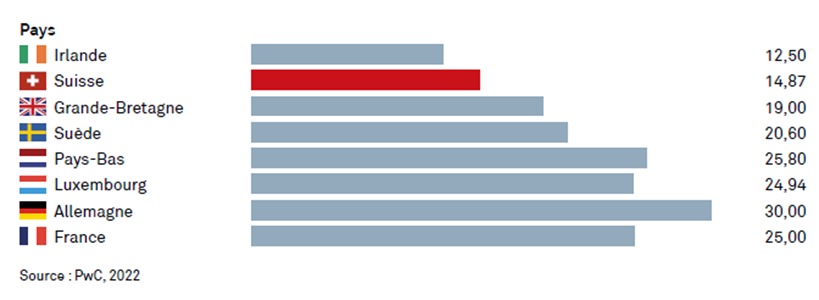
Corporate tax in Europe
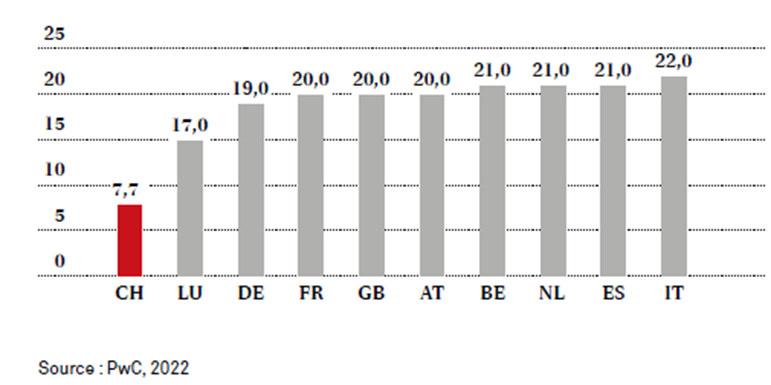
VAT in Europe
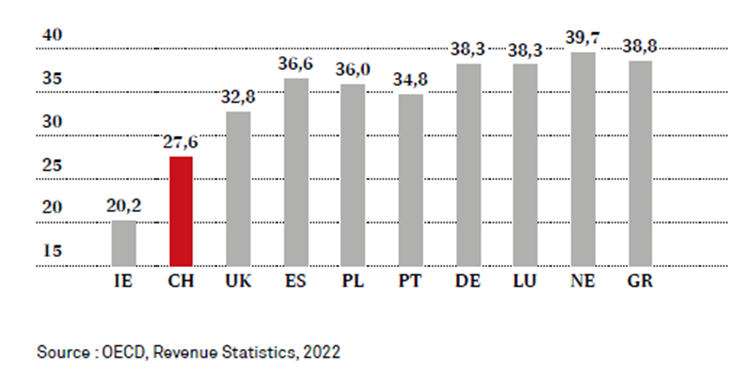
Tax shares in Europe
Taxes and contributions to social insurance 2020 in relation to GDP (in %)
The law governing public limited companies, as amended on January 1, 2023, has both advantages and some potential pitfalls for financial institutions.
The share capital may be denominated in EUR, GBP, USD or JPY provided that it is the most important currency in relation to the company's activities.
Adopted by Parliament in June 2020, the reform of the law of the public limited company (SA) came into force on January 1, 2023. The new provisions aim in particular to relax the rules on capital and foundation and to allow the formation of share capital in foreign currency.
In accordance with the timetable set by the Federal Council, the revision of the law of the public limited company, made concrete through the amendments to the Code of Obligations (CO) and the Ordinance on the Commercial Register (ORC), has been effective since January 1, 2023.
As part of the relaxation of capital and foundation rules, the reform introduces a new tool: the capital fluctuation margin.
Set in advance, this margin will allow the board of directors to increase or decrease the company's capital for a period of up to five years.
In addition, it will now be possible to establish the share capital of a company in certain approved foreign currencies.
Cryptocurrencies are excluded, however.
The reform also enshrined provisions concerning excessive compensation in law. Consequently, the Federal Council's ordinance against excessive compensation in publicly traded companies became obsolete and was repealed.
In addition to these new features, the reform also contains provisions concerning gender representation thresholds in the management of large companies and an increase in transparency in the raw materials sector.
Companies have two years (until January 1, 2025) to bring their articles of association into compliance with the new law. They will need to make these changes in order to benefit from the capital fluctuation margin.
Four legal changes that may be of practical interest to unlisted companies:
1. FOREIGN CURRENCIES
The share capital may be denominated in EUR, GBP, USD, or JPY, provided that this is the most important currency for the company's activities. If the share capital is denominated in one of these currencies, the accounts must be presented in that same currency, and in this case, the equivalent values in Swiss francs must also be shown.
The law governing public limited companies does not oblige the company to increase its share capital.
The share capital must be at least 100,000 francs, or its equivalent in foreign currency, at the time of incorporation of the company.
Assuming that a company is founded with capital in EUR and that this currency devalues, the company will, in fact, have a share capital of less than 100,000 francs.
The law governing public limited companies (SA) does not require them to increase their share capital. However, this situation can raise regulatory issues.
For asset managers, Article 22 of the Financial Institutions Act (LEFin) stipulates that a minimum capital of CHF 100,000 "must be maintained at all times." FINMA could require a capital increase under penalty of administrative measures.
2. INTERMEDIATE DIVIDENDS
A public limited company can distribute dividends to its shareholders during the financial year.
To do this, the company must prepare interim accounts and, if necessary, have these accounts reviewed according to the regime applicable to annual accounts (opting-out, limited or ordinary audit).
The payment of interim dividends is particularly important when the company is sold by its shareholders and is supposed to be free of retained earnings on the day of the sale.
3. INFORMATION FOR SHAREHOLDERS
In unlisted companies, shareholders representing together at least 10% of the share capital or voting rights may request information in writing from the board of directors at any time regarding the company's affairs.
The board of directors is required to provide the information within four months. This new law thus allows shareholders to obtain information on the company's operations without having to wait for a general meeting.
4. GENERAL ASSEMBLY
The practical arrangements for holding the general assembly are expanded.
meetings can now be held (i) at several sites simultaneously with live streaming between sites, (ii) without a physical meeting place (video conference only) if the statutes provide for it, or (iii) abroad if the statutes provide for it.
The Commercial Register rejects articles of association that do not comply with the law in force at the time of the registration application. In conclusion, the adoption of new articles of association has presented particular challenges since January 1, 2023; professional advice may prove useful in this context.
An intermediate solution to the general power of attorney
Observation :
With the evolution of medicine, life expectancy is constantly increasing, on a physical level, but this evolution rarely follows the same curve on a mental level.
After a certain age, memory loss and other mental impairments become commonplace.
The problem lies in no longer having the capacity to realize it when it occurs and not necessarily wanting to give immediate "general power of attorney" to these heirs or advisors when ideas are still clear.
Given the obvious need for future protection, a power of attorney for incapacity represents a good interim solution
Mandate for incapacity
A power of attorney for incapacity is a legal document that allows you to arrange your representation in the event of incapacity to make decisions. This will prevent you from being placed under state guardianship.
The mandate for incapacity was introduced with the new law on the protection of adults in 2013 and constitutes an essential element of legal provision.
Before drafting a mandate for incapacity, one must first understand what incapacity for discernment is.
What is the inability to make sound judgments?
The Swiss Civil Code defines the capacity for discernment as follows: "Any person who is not deprived of the ability to act reasonably because of their young age, mental deficiency, mental disorders, intoxication or other similar causes, is capable of discernment within the meaning of this law.
Loss of judgment can be temporary or long-term. A temporary loss of judgment can occur, for example, after an accident or as a result of drug abuse. Typical cases of permanent incapacity include dementia or severe mental disabilities.
Who decides on the incapacity of discernment?
Incapacity for judgment is rarely total and must be assessed individually.
Since the introduction of the new Adult Protection Act in 2013, the Child and Adult Protection Authority (APEA) has been responsible for assessing capacity. One of the APEA's main tasks is to decide on the measures to be taken to protect or support a person who has become incapable of making decisions.
The APEA assesses cases after receiving a report.
Anyone can send a report to the APEA. Certain authorities, such as the police or social services, are required to inform the APEA.
If no report reaches theAPEA, the latter will not take any action.
At what point does a mandate for incapacity come into effect?
A power of attorney for incapacity is not valid immediately upon its creation, but only in cases of incapacity for decision-making, as determined by the Child and Adult Protection Authority (APEA). The APEA must review and validate the power of attorney for incapacity. Only then, if the power of attorney is validated by the APEA, does it come into effect.
What is the difference between a mandate for incapacity and a general power of attorney?
The power of attorney is valid from the moment it is signed, whereas the mandate for incapacity is only valid after the occurrence of the incapacity to judge and its finding by the APEA.
Furthermore, banks generally no longer recognize powers of attorney after the onset of incapacity.
What is the difference between a power of attorney for incapacity and advance directives?
In the event of incapacity, govern advance directives medical care. A power of attorney for incapacity governs personal, financial, and legal matters. In the absence of advance directives, the representative designated in the power of attorney for incapacity for personal assistance decides on medical care.
What form should a power of attorney for incapacity take?
A power of attorney for incapacity is subject to strict formal requirements. It must either be handwritten and signed entirely by hand, or notarized. Notarization is particularly recommended if the person concerned is unable to write themselves.
Mandate for incapacity – General information
Or drop it off:
Keep your mandate in an easy-to-find place, ideally with other important documents.
Give a copy to the agent and inform them of where you deposited the original.
We recommend that you register the establishment and location of your power of attorney for incapacity in the civil registry of your municipality. Some cantons also offer the option of filing the power of attorney with the adult protection authority.
What does a power of attorney for incapacity contain?
The mandate for incapacity is divided into three areas: personal assistance, asset management, and legal representation. However, legal representation is always linked to personal assistance and asset management.
Who should I appoint as my representative?
Family members are often designated, particularly (adult) children. In some cases, however, this is not possible or desired – either by the principal or the agents. The following conditions must be met:
Representatives must have sufficient expertise. Even if they are allowed to use assistants, they assume responsibility for your entire life and finances.
Representatives need to be flexible and available: they must have enough time to handle everything and be able to travel there quickly. If your children are already very involved in their personal and professional lives or live too far away, this could become problematic in the long run.
When reviewing a power of attorney for incapacity, the Child and Adult Protection Authority (APEA) prioritizes minimizing conflicts of interest. Depending on the circumstances, appointing an heir as your representative may be problematic. Therefore, you should never designate someone who already manages your assets (banks, wealth managers, or trustees) as your representative. Reputable financial service providers refuse to be appointed as representatives in a power of attorney for incapacity.
The responsibility of a power of attorney for incapacity can extend over years, even decades. Your representatives should therefore be younger than you.
Where can I file a power of attorney for incapacity?
The most important thing is that it's easy to find.
The Child and Adult Protection Authority (APEA) does not bother to seek a mandate due to incapacity in the event of a report.
We therefore strongly advise against depositing your money order in a safe, bank or elsewhere.
However, the APEA is required to check in the register of the civil status office whether a mandate for incapacity has been registered.
We therefore recommend that you register your mandate for incapacity with the civil registry office of your place of residence.
Please note that you cannot file the mandate document at the civil registry office. However, you can indicate the filing location on the form provided by the civil registry office.
The deeds (Escritura de imóvel) : what you need to know
After going through the various stages of buying a house, from searching for the property, visiting, choosing, negotiating the price and signing the purchase contract, it is time to sign the deed.
Things you need to consider before completing a sale.
The act of purchase/sale (Escritura de um imóvel)
The notarial deed is the document by which the purchase and sale of real estate are established. It is carried out through a contract and constitutes the final stage of the entire process.
Normally, it is preceded by a preliminary sales agreement, in which a deposit is paid demonstrating the interest in purchasing the property. (**Information at the end of the document)
This document stipulates a deadline, followed by the completion of the transaction, if the buyer so desires. If the buyer does not wish to proceed with the transaction, they forfeit the deposit amount. (Deposit = O signal)
On the day of the transaction, the presence of both parties (buyer and seller) is mandatory for the signing. The document is signed before a competent official who certifies compliance with the law, thus attesting to the purchase and sale of the property. This official must verify and prove the identity of both parties.
The deed of sale and mortgage consists of two parts:
Purchase and sale contract, which corresponds to the moment when the buyer becomes the legal owner of the property
If the house is purchased with a mortgage, a private contract is drawn up, outlining all the loan terms. Only then does the bank release the funds requested by the client for the purchase of the house.
Required documents
Civil and tax identification documents of the participants;
Purchase and sale order contract for the property
Caderneta Predial Urbana or Application for registration of property in the register (IMI Model I) issued by the Tax and Customs Authority
License to use
Building technical specifications
Energy certificate
Content certificate
Infrastructure Certificate
Mortgage deeds
Certificate of toponymy
Payment of the IMT (municipal tax on property transfer).
Payment of stamp duty.
Where to obtain the deed of ownership (in person and online)
All costs associated with the transaction are normally borne by the homebuyer. There is no precise value that can be assigned to this process, as it depends on a number of factors, namely:
Purchase price of the house;
Whether it is a first or second residence;
Expenses related to the payment of stamp duty on the transaction;
Stamp duty on credit;
Registration of the deed;
Fees with home loan services, registration office or notary;
Costs associated with the payment of the IMT (IMT = value of the deed or value of the wealth tax (whichever is higher) x applicable rate – deductible portion. IMT rates can be consulted on the financial portal ;
Place where the deed will be drawn up.
Registration of the act
Fees with CASA Pronta services, the registry office or the notary. Costs associated with the payment of IMT (IMT = value of the deed or value of the wealth tax (whichever is higher) x applicable rate – deductible portion. IMT rates can be found on the financial portal);
Registration deadlines
This can take more or less time, depending on the time required to complete the various stages of buying and selling a property.
Generally speaking, and as a guideline:
Obtaining the title certificate or the land registry certificate – 5 to 20 days;
Residence permit – 7 to 30 days;
Purchase and sale agreement – 7 to 30 days;
Signing of the deed – 14 to 90 days;
Conclusion of the case in order to obtain the title certificate and the land registry certificate
It takes 1 week to 1 month to receive the occupancy permit if the seller does not already have one
1 week to 1 month to negotiate the terms of the order contract
2 weeks to 3 months to sign the deed and pay the balance to the seller
Registration at the land registry office after the deed – 30 days.
Types of real estate transactions
There are several types of deeds, which differ according to the objective and type of transaction. Below is an exhaustive list
Act of buying and selling – the most common and best known;
Purchase and sale transaction with recourse to a financial institution – equal to the previous one but with intervention of the bank, due to the need for credit;
Deed for inherited property – the deed is usually drawn up by the organizations mentioned above. The property must be in your name to be sold. It is important to address this point before selling an inherited house;
Deed for a property under construction – A deed is signed between two parties and can be an advantageous deal because it is generally a cheaper purchase, the property is new, and you have more time to plan. However, it also has its disadvantages: the work may not be completed or may be completed later than expected, and the finishes may be different from what you had envisioned;
Property given by notarial deed – the process is the same but there is no associated property value, in other words, there is no cost to the buyer when purchasing the property;
Exchange of ownership deeds – the deed consists of the exchange of properties and may or may not have associated values, depending on the value of the properties. If they have different values, the party owning the property with the lower value will have to pay the remaining value.
Preliminary sales agreement
(Contrato de promise de compra e venda)
CPCV. This will certainly be an acronym that many people will be familiar with. We are talking about the preliminary sales agreement, which is fundamental when buying a house, both for the current owner and for those interested in purchasing the property.
As the first phase in the property purchase process, the CPCV (Construction Purchase Agreement) proves very useful for those who want to buy a house. Although not mandatory, it is the mechanism used to formalize the intention to buy by the prospective buyer and the intention to sell by the prospective seller.
In addition to offering great protection to the contracting parties, particularly with regard to situations of default of payment, it makes it possible to exclude other interested parties from the purchase of the good.
What are the advantages of signing a CPCV?
By signing a CPCV, the contracting parties guarantee the validity of the contract until the signing of the public act, stipulating their rights and duties, the date of conclusion of the final contract, the agreed values and the remaining clauses to be included in the future contract.
The order contract is even more advantageous in the case of buying and selling real estate since, between the time the parties decide to contract and the signing of the final contract, the conditions necessary for the public act may not be met.
For example, if the buyer doesn't have the necessary funds to purchase the property, there will be a waiting period for mortgage approval from the bank, or if the property is still under construction or doesn't have a building permit, it's useful to sign a CPCV (Construction Contract for Sale and Purchase). This contract formalizes the negotiation between the contracting parties.
In addition, the order contract offers greater legal certainty in the relationship between the order seller and the order buyer, as it defines the consequences in the event of late payment or breach of contract by the parties.
The advance payment (Sinal) : What is its purpose?
As a general rule, in preliminary sales contracts, the prospective buyer pays a certain sum of money to the prospective seller as an advance (Sinal) or principal payment of the property price. This amount is called a deposit, in accordance with Article 441 of the Portuguese Civil Code. In the case of a contract executed on behalf of the seller, the deposit is included in the payment due when it coincides with the latter, pursuant to Article 242, paragraph 1, of the Portuguese Civil Code.
What happens if the promise contract is not fulfilled?
The consequences of breaching a contract, such as a promise to sell, can be defined by the parties to the contract. If the parties do not stipulate otherwise, the general provisions of Article 442 of the Civil Code apply
If the non-compliance is due to the buyer of the promise, that is to say the party who delivered the deposit, the latter will be abandoned in favour of the counterparty;
If the non-conformity is the fault of the promising seller, i.e. the party who received the deposit, the deposit must be refunded double.
If the goods referred to in the promised contract are delivered, the promising buyer may choose, instead of receiving double the deposit, to receive the current value of the goods at the time of breach, less the agreed price, plus the deposit and the portion of the price already paid. This solution, enshrined in paragraph 2 of Article 442 of the Civil Code, aims to prevent unjust enrichment of the defaulting party. Otherwise, the double deposit could be advantageous, and consequently, default would also be advantageous.
As stipulated in Article 830, the non-performance of a contract by order also grants the non-defaulting party the right to seek specific performance of the contract. Through this mechanism, the debtor is substituted in the performance, and the creditor obtains satisfaction of their right through legal proceedings, thus establishing the definitive contract. It should be noted that current legislation presumes that the existence of a deposit eliminates the possibility of specific performance of the contract by order, in light of the provisions of Article 830(2) of the Civil Code. However, this presumption is rebuttable.
The “chain transfer” of capital gains tax is based on the harmonized tax law of the cantons and municipalities.
The term “chain deferral” refers to the (theoretical!) possibility of indefinitely deferring capital gains tax based on various elements of the deferral linked together.
Real estate capital gains tax
In the event of the sale of real estate, capital gains are subject to real estate gains tax. This results in a gross profit to the extent that the proceeds exceed the investment costs (purchase price or equivalent value, expenses) (Art. 12 para. 1 LHID). Depending on the cantonal regulations governing real estate gains tax, certain deductions may be made from the gross profit.
The law equates several other legal acts (Art. 12 para. 2 LHID) with a true change of ownership under civil law, which constitutes the most important case of application. Examples include the sale of shares in a real estate company ("economic transfer"), the transfer of real estate from private to business assets ("change of system"), or the creation of private easements on real estate.
The determining parameters for calculating thetaxon real estate gains, such as "product", "investment costs"and "replacement value", are legal concepts that are not specified by theharmonization.
However, the concept of".lawbe prescribed by harmonizationOverall, the Confederation therefore leaves the cantons and municipalities some leeway in defining the concept.
In the 25 years since the harmonization legislation came into force, cantons and municipalities have seen a surprising diversity of practices, particularly with regard to thedeferraloftaxation.
As long asacantonal or municipal practice is not challengedbeforethe Federal Supreme Court, it remains uncontested. Federal law does not provide for anyinstrumentharmonization".
Thisiswhy the tax base (gross profit) mayvaryfromonecanton to another,despite identical factual situations, and not only because of different tax scales.
For the deferral or transfer of capital gains to another canton, it is therefore crucial to know in which canton the amount of the deferred capital gainisdetermined. As will be seen below, the deferred profitisalways determined in the canton where thepropertyis sold. This canton applies its own law.
Deferred taxation
The deferral of taxation suspends the calculation of the increase in value made on the property, even if there has been a change of ownership or a similar event.
The deferral of taxation is therefore an exception to the general principle of realization. The legal transaction is treated, in a way, as if the gross profit had not (yet) been realized.
Tax deferral may only be granted by the cantons in the five specific cases expressly and exhaustively listed by the federal legislator in Art. 12 para. 3 let. a — e LHID. These are as follows:
In the event of transfer of ownership by inheritance (devolution of inheritance, division of inheritance, legacy), advancement of inheritance or donation (case of inheritance law);
In the event of a transfer of property between spouses in connection with the matrimonial regime or in the event of compensation for extraordinary contributions by one spouse to the maintenance of the family (art. 165CC) or for claims arising from divorce law, provided that both spouses agree (family law case);
In the event of land parcel reorganization (case of forced transfer);
In the event of the total or partial sale of an agricultural and/or forestry property, provided that the proceeds of the sale are used, within a reasonable time, for the acquisition of a replacement property operated by the taxpayer himself or for the improvement of agricultural or forestry properties belonging to the taxpayer and operated by him. (scenario "agricultural replacement acquisition");
In the event of the sale of a dwelling (house or apartment) which has been used permanently and exclusively by the seller, provided that the proceeds obtained are used, within a reasonable timeframe, for the acquisition or construction in Switzerland of a dwelling used for the same purpose (in the case of the acquisition of a replacement property).
These five scenarios that generate deferred taxation are systematically subdivided into clearly defined groups of cases, including:
A group of replacement acquisitions (Figures 4 and 5), a group in which the owner does not receive consideration for the transfer of the property (inheritance law, (figure 1) a) or within the family (family law, (figure 2)), as well as a group which includes transfers of properties based on constraint (land consolidation, (figure 3).
It is possible to distinguish two types.
In the first case, the tax subject remains the same, while the building "changes" (particularly for replacement acquisitions [figures 4 and 5]).
In the other case, the building is not affected and the modification takes place via the exchange of the tax subject (in particular in the case of a transfer of ownership between spouses or a transfer of a deferral of taxation is replaced by another event triggering deferral of taxation, the corresponding conditions are also exchanged.
The reason the federal legislature created the five scenarios, thereby introducing the deferral of taxation, lay in important economic, social and (privileged) policy motives.
In the event of a change of ownership, the cantons and municipalities are required to temporarily waive taxation of the gross profit. The principle is essentially: "not now, but later".
Due to the exhaustive list, cantons and municipalities are also not permitted to create other scenarios that trigger deferred taxation. For example, real estate acquired as a gift (item 1 or 2). Within the framework of this systematization, it is important to bear in mind that each scenario has different conditions that must be met for deferred taxation to be granted.
Boundaries
Tax deferral must be distinguished from exemption; the two legal mechanisms have significant conceptual differences: tax deferral lasts until the preferential grounds for deferral disappear. If the grounds for tax deferral disappear, or if all the conditions of a given scenario are no longer met, taxation occurs, and the capital gain on the property becomes the subject of the tax.
Taxation therefore remains possible after years of deferral.
On the other hand, in the case of tax exemption, the right to tax disappears from the moment the conditions are met and further taxation is no longer possible after several years – which can be illustrated using the formula “not now, nor later”.
It should also be clarified that the deferral does not constitute a taxable event for the tax reassessment within the meaning of Article 53 of the Federal Act on the Harmonization of Direct Taxes (LHID), since the elimination of the tax deferral does not constitute an event within the meaning of Article 53 paragraph 1 or Article 51 paragraph 1 letter a of the LHID: It is not taxed retroactively, as what should have already been taxed at the time is not the case. Rather, it is a matter of taxing when the reasons for the tax deferral cease to exist.
Requirements for replacement acquisition
The concept of "replacement property" is defined in a binding manner for the cantons and municipalitiesby the harmonization rule of Art. 12 para. 3 let. d and e LHID. The cantons and municipalities cannot autonomously define the legal concept governed by federal law.
This is all the more true since replacement acquisition is also permitted beyond cantonal borders.
On the other hand, it remains the responsibility of the cantons to set the scales, rates and amounts exempt from tax (“social deductions”) (cf. art. 1 para. 3 2 sentence LHID).
Both the original alienated object and the replacement object acquired must be occupied as 'a dwelling used permanently and exclusively for the alienator's own use'.
“Dwelling” means that the owners establish their civil or tax domicile at the place of the property being evicted.
The term "dwelling used for the owner's own use" therefore refers only to the principal residence, whereas a secondary tax residence cannot be taken into account for deferred taxation in the case of a holiday property.
In the case of a two-year lease by a third party, the Federal Court ruled that there was no longer any separate use of the property.
In principle, use by a third party (such as renting to third parties) therefore excludes own use.
In the event of a deferral following a replacement purchase, it is therefore recommended to allow, at most, short-term use of the property by a third party. Otherwise, the tax authority may no longer consider the condition of "permanent and exclusive use for one's own purposes" to be met and may levy a tax on capital gains from real estate.
The Federal Supreme Court explicitly leaves open the question of the timeframe within which the replacement acquisition must take place. The cantons may themselves determine the length of the "appropriate period" within which the replacement acquisition must occur.
Most cantons generally allow a period of two to five years.The Federal Supreme Court subsequently ruled that a seven-year gap between the sale and the replacement purchase was no longer appropriate in any case.
Furthermore, replacement acquisition can be carried out not only retroactively, but also in advance. In this case, it is referred to as "anticipatory replacement acquisition".
Method of transferring a gain whose taxation has been deferred
The transfer of the gain whose taxation has been deferred is based on two methods approved by the Federal Court.
Application of the "absolute method"
The "absolute method". According to this provision, deferred taxation is granted only for the portion of the profit invested in the acquisition of the replacement item after reusing the investment costs of the item sold (and any third-party services).
If the funds allocated to the replacement property do not exceed the investment costs of the property sold, the capital gain is taxed in full.
In this case, there is no deferral of taxation on capital gains from real estate. The profit is considered realized and not reinvested. Any profit not reinvested is taxed immediately. Therefore, the deferral of taxation under Art. 12 para. 3 let. e of the LHID (Land Tax Act) should only be granted if and to the extent that the proceeds reinvested in the replacement property exceed the investment costs of the initial property.
Application of the "unit method"
It becomes interesting that the deferral of taxation of real estate gains takes place beyond cantonal borders.
The question that arises is which canton is granted fiscal sovereignty over the initial real estate profit.
In inter-cantonal relations, the Federal Court has ruled in favour of applying the "unitary method" while excluding the "division method"
Thus, the deferred gross profit (and therefore the latent tax base) is allocated in its entirety to the canton of arrival in whose territory the alienation of the replacement property takes place, without any further deferral of taxation.
Gross profits form a single taxable object in the (last) canton of arrival, hence the designation of "single method".
The method of splitting, also discussed in doctrine, according to which the last gross taxable profit is distributed proportionally between the canton of departure and the canton of arrival (or cantons of arrival), has no basis in federal law.
The Federal Court thus confirms that not only are the latent reserves transferred to the other canton, but that jurisdiction and sovereignty in matters of taxation also change from one canton to another.
In other words: "not now, but later" means, from a procedural point of view, that only the taxing authority of the "last" canton should act, exclusively applying its own law.
From a material point of view, the entirety of the last gross profit goes to the "last" canton alone; the other cantons receive nothing.
Delayed due to a change in tax subject
The second type of deferral, through a modification of the tax subject, includes the assumptions of inheritance law and family law (figures 1 and 2).
The canton where the property is located cannot, despite a change of ownership under civil law, levy capital gains tax on the transferred property. According to the jurisprudence of the Federal Supreme Court, the reservation of usufruct does not lead, from an economic perspective, to a significantly different outcome than the transfer of ownership under civil law upon death.
The Federal Court thus emphasized that art. 12 para. 3 let. a LHID expressly includes inter vivos acts of succession (“advancement of inheritance”) and even donations based on the law of obligations.
Regarding the advancement of inheritance (which also applies to the donation of real estate), the Federal Supreme Court recently ruled that the deferral of taxation can also be invoked in the case of a mixed legal transaction. The "free" portion must not exceed a certain threshold.
The "chain deferral"
It is particularly interesting to know what happens to the extension of the deferral of taxation when one event triggering deferred taxation is followed by another event triggering deferred taxation, that is to say when the groups of cases are combined.
Example 3: Daughter C. receives a share of a condominium from her mother. The apartment not meeting her own needs, she sells the condominium share for 700,000 francs and acquires a replacement building for 850,000 francs.
Combination possibilities and limitations
The law on tax harmonization does not expressly provide whether a taxable event for deferred taxation can be replaced by another taxable event for deferred taxation.
As we have seen, the harmonized tax law of the cantons and municipalities only covers the five cases of events triggering deferred taxation, which are exhaustively listed.
Given the principle of horizontal and vertical harmonization and the fundamental importance of the conditions, existence, and revocation of tax deferrals, the Federal Supreme Court held that the possibility of combining these two elements is solely a matter of federal law. Consequently, the cantons cannot establish their own combination mechanisms, which is appropriate, since neither the cantons nor the municipalities can create new taxable events for deferred taxation.
As long as the uninterrupted connection of a new element to the old constituent element of a taxable event is guaranteed and the latent tax liability is fully maintained, the taxpayer may, of his or her own volition, move from one taxable event to another.
The Federal Court thus denied the establishment of a fact or a link between facts.
The change between the different events that trigger deferred taxation is thus based on federal law and the different scenarios can therefore be combined in different ways.
Informative processing of the "delayed chain"
In the case of a chain deferral that is somehow "infinite", it can be problematic that the deferred benefitcanno longer be reconstituted after decades.
This becomes particularlydifficultwhen several replacement acquisitions have already taken place beyond the cantonal borders.
In this regard, it is important that the taxpayer be required to cooperate (in particular by providing information) with all tax authorities involved in the intercantonal replacement acquisition.
Next, the canton granting the replacement acquisition ("departure canton") communicates its decision to the tax authority of the canton where the replacement property is located ("arrival canton").
These obligations to provide information and to inform are intended to guarantee information on the reference values that define the amount of the real estate gain and the amount of the reinvestment.
Only when the reference values are known can it be determined, when applying the absolute method, whether and to what extent tax deferral should be granted.
Furthermore, according to the case law of the Federal Court, there is a right to obtain a declaratory decision fixing the amount of the (deferred).
In theinterestof legal certainty, taxpayers would be well advised to have the extent of the tax deferral determinedassoonafterpossibleasthereplacementinvestment. To do so, thetaxauthority must, as previously mentioned,issue a declaratory judgment, which is subject to the ordinary legal and appeal procedures.
The end of the "chain deferral"
The tax deferral ends when:
A requirement is not met or disappears within a group of cases (e.g. the replacement property is no longer used "on a permanent and exclusive basis" or a spouse does not accept the deferral when transferring property into the matrimonial regime); or if the transition to another group of cases fails (e.g. there is no replacement investment within a "suitable timeframe"); or a final disposition takes place.
At the end of the chain, the calculation must be based on the last real estate gain made.
Profits earned previously and which are subject to tax deferral are not taken into consideration.
In particular, there is no aggregation of all gains ever realized. The calculation is "completely normal", that is to say, based on the last gross profit obtained, without any further tax deferral.
Capital gains on real estate are taxed, as we have seen, in the absence of another event triggering deferred taxation ("at the end of the chain"). The rules in force at that time (tax brackets, tax base, etc.) are decisive
Any event that triggers deferred taxation can be replaced by a similar or legally permissible event that also triggers deferred taxation, without immediate taxation occurring. Thus, a "weaving" exchange between different events that trigger deferred taxation is also permitted.
Challenges arise in particular when events triggering deferred taxation occur in inter-cantonal relations.
According to the "unitary method," the last canton where the property is located—that is, the one in which there is no further deferral of taxation—is authorized to tax the gross profit realized on the last transfer, applying its own tax law. Documenting these successive tax deferrals is therefore of great importance, particularly for this reason.
The global tax landscape is changing with repercussions for Switzerland and the companies based there.
According to the roadmap established by the OECD and the G20 countries, the first elements of a minimum tax should come into force on January 1, 2023.The Federal Council has therefore decided to implement the minimum tax through a constitutional amendment and to ensure, by means of a transitional ordinance, that the minimum tax can be introduced on January 1, 2024. Voters will be called upon to decide on this matter on June 23, 2023.From a tax perspective, Switzerland remains an attractive place for both businesses and individuals, but with the introduction of a global minimum tax on large corporations in mind, some cantons must prepare to tax them more heavily. In light of the reforms envisioned by the OECD and the G20 countries, which plan tointroduce a minimum corporate profit tax rate of 15%, the differences between cantons with low corporate tax rates, such as Zug (11.85%), and Bern (21.04%), which levies high taxes, are expected to diminish. However, the OECD's proposed minimum 15% tax rate will only apply to companies with annual revenues exceeding €750 million.In French-speaking Switzerland, the cantons of Vaud and Geneva have set their corporate profit tax rates at 14%, Neuchâtel at 13.57%, Fribourg at 13.87%, Valais at 17.12%, and Jura at 16%. Compared to the OECD's minimum rate of 15%, the difference is not very large, and these cantons will only need to make minor adjustments to comply with OECD rates. In German-speaking Switzerland, the canton of Zug leads the ranking with a rate of 11.9%, followed by Nidwalden (12.0%) and Lucerne (12.2%). With a rate of 21.0%, the canton of Bern is at the bottom.
2022 Corporate Tax Rates in Switzerland: In international comparison, companies are taxed lightly in Switzerland. Rates lower than those in low-tax cantons are only found in traditional offshore jurisdictions, Guernsey, Qatar, and a few Eastern (Southeast) European countries. Ireland remains Switzerland's main competitor in Europe. Internationally, large Swiss companies will also be subject to the same rules as those located in cities like Singapore, Hong Kong, or Dubai, which will also have to raise their tax rate to 15%. There will therefore be fewer incentives encouraging companies to relocate to such locations solely for tax reasons. For very large corporations, tax competition between cantons will play a less significant role as a factor in future location decisions. Whether these corporate tax developments will have consequences for personal income tax remains to be seen.
To provide the best experiences, we use technologies such as cookies to store and/or access device information. Consenting to these technologies will allow us to process data such as browsing behavior or unique IDs on this site. Failure to consent or withdrawing consent may negatively impact certain features and functions.
Functional
Always On
The storage or technical access is strictly necessary for the purpose of legitimate interest to allow the use of a specific service explicitly requested by the subscriber or user, or for the sole purpose of carrying out the transmission of communication over an electronic communications network.
Preferences
The storage or technical access is necessary for the legitimate interest purpose of storing preferences that are not requested by the subscriber or user.
Statistics
Storage or technical access used exclusively for statistical purposes.Storage or technical access used exclusively for anonymous statistical purposes. In the absence of a subpoena, voluntary compliance from your internet service provider, or additional records from a third party, information stored or retrieved for this sole purpose generally cannot be used to identify you.
Marketing
Storage or technical access is necessary to create user profiles in order to send advertisements, or to track the user across a website or across multiple websites with similar marketing purposes.