The real estate market is easing. Swiss mortgage rates are falling
The decline in inflation leads to a decrease in interest rates, particularly those applied to construction.
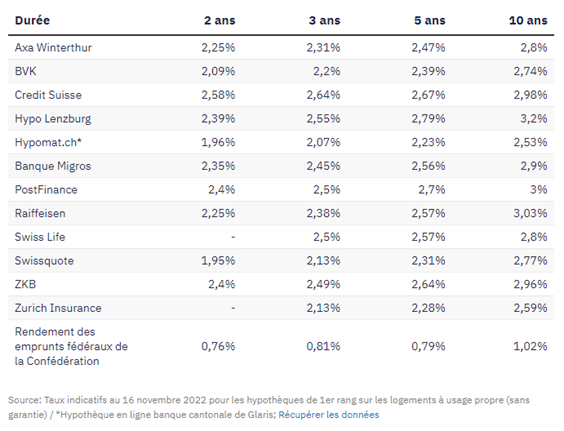
Over the past four weeks, mortgage rates have fallen significantly in Switzerland. All twelve lenders whose indicative rates for fixed-rate mortgages are regularly collected by the magazine "Finanz und Wirtschaft" have lowered their rates, sometimes considerably. All loan terms are affected.
For ten-year terms, indicative rates have fallen by an average of 0.38 percentage points. The Zurich Cantonal Bank and Swiss Life have lowered their rates by 0.46 percentage points for ten-year fixed-rate mortgages. Zurich Insurance has even reduced its indicative rate by 0.48 percentage points for five-year mortgages. By comparison, the average market decrease is 0.32 percentage points for a five-year term.
Fixed mortgage rates in %
Mortgage interest rates of 3% or more for ten-year contracts seem to be a thing of the past, at least for now.
Last month, all but one institution still required rates of 3% or more. Now only three do: Hypo Lenzburg, Raiffeisen, and PostFinance.
Rates below 2% are once again possible for short-term loans. These are offered by Swissquote and the online platform Hypomat, which is backed by the Glarus Cantonal Bank.
Inflationary pressure is decreasing
The general downward correction indicates that the inflationary environment has eased. In Switzerland, the annual increase in consumer prices fell in October for the second consecutive month, reaching 3%. This remains well above the Swiss National Bank's price stability target of 2%.
Last week, National Bank President Thomas Jordan reiterated that the key interest rate is expected to be raised again in December. However, inflation is on track as predicted by the custodians of the currency, who anticipate a decline to 2% and even lower next year. The pressure to set the key interest rate significantly higher is therefore easing.
It remains to be seen whether today's significant drop in mortgage rates truly represents a trend reversal. Following the correction in July, this is only the second monthly downward adjustment this year. Overall, ten-year mortgages are still more than twice as expensive as they were at the beginning of the year.
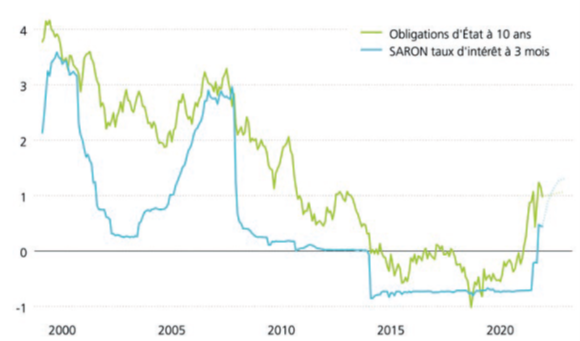
SARON 3-month returns and 10-year actuarial returns, expressed as a percentage
Market expectations regarding interest rate trends are reflected in the futures markets.
According to forecasts, short-term interest rates measured by the 3-month SARON in Switzerland are expected to rise by 0.75 percentage points over the next twelve months.
If this hypothesis is confirmed, the cost of Saron mortgages will also increase by 0.75 percentage points. However, it is long-term fixed-rate mortgages that have seen the largest rate increase, as they align with the evolution of long-term rates in the capital markets.
PORTUGAL – HINDRANCE TO GOLDEN VISA – VENTURE EQUITY INVESTMENT
Solutions and changes 2022
GOLDEN VISA and ARI are doing well, investments more than doubled in September 2022, however the brake on GOLDEN VISA in the metropolitan areas of Lisbon and Porto is fueling other ways of obtaining a residence permit (ARI), namely venture capital investment.
Currently, under the new regime, "203 applications are pending analysis for capital transfers of 350,000 euros or more, for the acquisition of participation units in investment funds or venture capital funds focused on company capitalization, which are constituted under Portuguese law.".
The Securities Market Commission (CMVM) is paying close attention to this new way of obtaining a residence permit, and considers that venture capital investment is being made without respecting all the rules aimed at preventing the entry of money of illicit origin into Portugal, particularly through real estate.
Despite the new legislation, it is still possible to invest in real estate under the ARI scheme. Opportunities still exist in the real estate and capital transfer sectors for foreign investors in Portugal under the Residence Permit for Investment (ARI) scheme.
What changed in 2022
The changes generally represent an increase in minimum capital investment amounts, as well as limitations on the geographical areas for which real estate investment for housing purposescan be applied.
Real estate investment:
A minimum amount of Euros 500,000.00, for housing purposes, will only be allowed in Portugal, the Azores and Madeira.
A minimum amount of 350,000.00 euros, with rehabilitation work, for residential purposes, is only permitted in Portugal, the Azores and Madeira.
Capital transfers :
The transfer of capital equal to or greater than 1 million euros will be subject to a minimum investment of 1.5 million euros ;
The minimum amount of investment in capital transfers intended to be applied to research activities developed by public or private scientific research institutions, integrated into the national scientific and technological system, increases from EUR 350,000.00 to EUR 500,000.00;
The minimum investment amount for capital transfers for investments in private equity fundswill be increased by
€350,000.00 to €500,000.00;
The minimum amount of investment in the transfer of capital for the formation of a company in Portugal, associated with the creation of five permanent jobs, or for the strengthening of the share capital of a Portuguese company, with the creation or maintenance of these jobs, increases from €350,000.00 to €500,000.00.
Exceptions
The geographical limitations that will occur in real estate investment for housing purposes, by "pushing" investment inland and towards the islands, will allow that there are still several investment opportunities, with high potential, which will allow the promotion and development of certain areas of the country;
These limitations on real estate investment will apply "only" to properties intended for residential purposes, meaning that foreign investors will be able to continue investing throughout the country, including Lisbon, Porto and the coast, in properties that are not intended for residential purposes (commercial, services, other), even after January 1, 2022;
The planned changes do not affect the possibility of renewing the ARI or the granting/renewal of residence permits for family reunification (provided that the investor's file has been submitted in accordance with the current law).
The risks facing the European real estate market in the coming months
Demand for new housing is being affected by rising interest rates and inflation, and margins are being squeezed by construction costs, predicts S&P.
Property developers and builders across Europe should prepare for challenging times. According to S&P, several external factors are likely to impact the new construction sector over the next 12 to 18 months. Rising interest rates, inflation, and energy costs stemming from the Russo-Ukrainian conflict could have repercussions for the European real estate market.
Interest rates and inflation: how they affect the housing market
According to S&P, current conditions could lead to a decline in sales volume. The market is heavily reliant on mortgages (70% of newly built homes in Europe are financed with home loans), which are influenced by interest rates and lending conditions.
Uncertainty may lead families to postpone buying a new home, as rising property prices, linked to inflation, and the increased cost of living are not accompanied by a rise in real wages. Portugal, for example, has the largest gap between housing prices and wages in the OECD, with housing costs exceeding labor income by 47.1% in the first quarter of 2022.
In addition, the conflict between Russia and Ukraine, as well as problems in the global supply chain, are leading to increased costs and shortages for builders, which may delay and make projects more expensive.
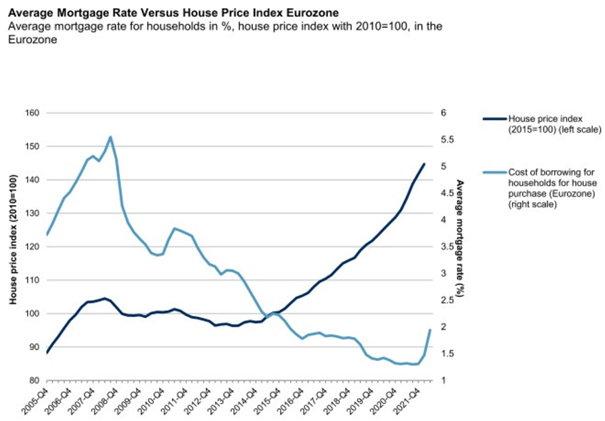
Housing prices in Europe
To maintain profit margins, S&P states that cost optimization plans and strong cash reserves are necessary. Furthermore, among the factors driving prices is a shortage of new housing. In Portugal, for example, demand for real estate relative to supply has caused housing prices to skyrocket in recent years.
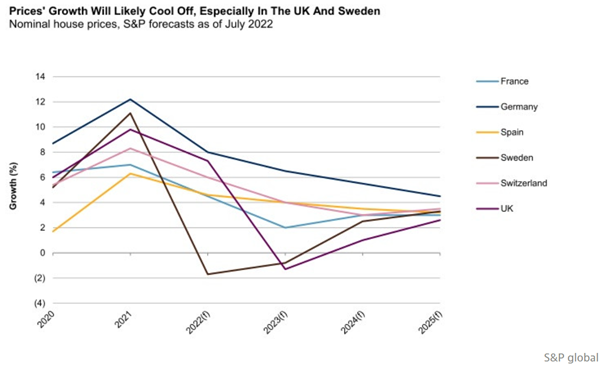
Forecast on European real estate
Here are the main trends identified by S&P for the coming months in the new construction sector:
Rising interest rates and weakening purchasing power are expected to reduce demand for new housing in Europe, a market that relies primarily on mortgage loans, even if government incentives can act as a stimulus.
In addition, rising construction costs, energy costs (which account for 5 to 10% of price increases), labor shortages, land scarcity, and supply chain problems continue to hinder the delivery of housing units.
Stricter environmental and safety requirements are driving demand for new construction, but are also resulting in additional costs and technical challenges for builders.
It is therefore expected that during the last quarter of the year, European property developers and builders will already begin to experience increasing pressure on revenues and margins, as it will be difficult to pass on the increase in costs to end customers.
The bulk of the impact is not expected to be felt until 2023. However, most European property developers rated by S&P should overcome the obstacles and maintain credit parameters in line with annual ratings, thanks to strong balance sheets and good levels of liquidity.
Foreigners have been and continue to be the driving force behind the strong growth of the Portuguese real estate market in recent years.
Portugal remains one of the best countries for retirees.
Since COVID and the upheavals it caused, it has also become very popular for temporary stays by remote workers.
The legal framework for entry, stay, exit and expulsion presents interesting new features which will undoubtedly appeal to some of you.
The decree of the Assembly of the Republic, promulgated by the President of the Republic on August 4, 2022, introduces the 10th amendment to the Law on Environmental Protection. Law No. 23/2007,the Law on Foreigners, of July 4,
The new law on foreigners in Portugal was approved by the Portuguese Parliament on July 21, 2022.
What are the main new features of the new law on foreigners in Portugal?
This type of visa allows its holder to reside in Portugal in order to work there, even remotely, for a person or company whose residence or registered office is outside the national territory.
Temporary residence visa
This visa is granted for the duration of the stay and is valid for multiple entries into the national territory.
Residence visa for job seekers
The visa for " procura de trabalho " allows its holder to enter and remain in Portugal to look for work and authorizes them to engage in dependent work until the visa expires or until a residence permit is granted.
This visa is valid for 120 days and can be extended for an additional 60 days.
At the end of the 180-day period, if the holder has not yet signed an employment contract and applied for a residence permit, he must leave the country and is only allowed to apply for a new visa to seek employment one year after the expiry date of the previous visa.
How can the holder of this visa obtain a residence permit in Portugal?
If you have already formalized your employment relationship before the aforementioned appointment date and if you meet the general conditions, you can acquire a residence permit in Portugal.
This residence permit is valid for two years from the date of issue of the residence card and is renewable for successive periods of three years.
Another major legal change , and one closely linked to the creation of this new type of visa, is the elimination of worker quotas in the visa for the exercise of subordinate professional activity.
In addition to the creation of new types of visas, the following procedural measures should also be highlighted:
Facilitating the process of obtaining a residence visa for studies in higher education
When an applicant is admitted to a national higher education institution, the granting of a residence visa to pursue a higher education program is now exempt from the prior opinion of the European Commission. SEF.
The consulate consults the second generation Schengen information system (SIS II) directly and can only refuse the visa if a refusal of entry and stay is reported in the SIS II.
b) The consulate immediately notifies the SEF of the granting of the visa, and the SEF may activate police measures on the national territory, within the framework of border control, or even cancel the visa.
Automatic assignment of a temporary TIN, NISS, and user ID as part of a residence visa application
When the residence visa is granted, a prior residence authorization is issued, containing information concerning:
Obtaining a residence permit;
Provisional allocation of tax and social security numbers and user number.
It's important to take some precautions, identify potential opportunities and risks, and follow the advice below:
Invest only if your cash flow is significant and the expected return is attractive. These are the two essential criteria for your strategy to be successful.
Invest only if you have a substantial down payment. Taking out an 80% "buy-to-let" mortgage is too risky.
Base your decision on the expected net return. Neglecting maintenance, other expenses, or taxes could lead you to make a poor decision.
Don't invest all your money in real estate. Remember that the key is to have a diversified asset portfolio to protect yourself against a downturn in the real estate market.
Never forget that in a condominium association, you are not the sole decision-maker. It would indeed be a shame if your plans were thwarted by a decision of your condominium association's board of directors. For example, they could prohibit you from renting through sites such as Airbnb.
If you have some capital, attractive returns can be obtained provided you make a good investment, which means you need to do some research and try to minimize the risks.
Investing in real estate using a "buy to let" strategy remains particularly attractive in Switzerland.
The global tax landscape is changing with repercussions for Switzerland and the companies based there.
According to the roadmap established by the OECD and the G20 countries, the first elements of a minimum tax should come into force on January 1, 2023.The Federal Council has therefore decided to implement the minimum tax through a constitutional amendment and to ensure, by means of a transitional ordinance, that the minimum tax can be introduced on January 1, 2024. Voters will be called upon to decide on this matter on June 23, 2023.From a tax perspective, Switzerland remains an attractive place for both businesses and individuals, but with the introduction of a global minimum tax on large corporations in mind, some cantons must prepare to tax them more heavily. In light of the reforms envisioned by the OECD and the G20 countries, which plan tointroduce a minimum corporate profit tax rate of 15%, the differences between cantons with low corporate tax rates, such as Zug (11.85%), and Bern (21.04%), which levies high taxes, are expected to diminish. However, the OECD's proposed minimum 15% tax rate will only apply to companies with annual revenues exceeding €750 million.In French-speaking Switzerland, the cantons of Vaud and Geneva have set their corporate profit tax rates at 14%, Neuchâtel at 13.57%, Fribourg at 13.87%, Valais at 17.12%, and Jura at 16%. Compared to the OECD's minimum rate of 15%, the difference is not very large, and these cantons will only need to make minor adjustments to comply with OECD rates. In German-speaking Switzerland, the canton of Zug leads the ranking with a rate of 11.9%, followed by Nidwalden (12.0%) and Lucerne (12.2%). With a rate of 21.0%, the canton of Bern is at the bottom.
2022 Corporate Tax Rates in Switzerland: In international comparison, companies are taxed lightly in Switzerland. Rates lower than those in low-tax cantons are only found in traditional offshore jurisdictions, Guernsey, Qatar, and a few Eastern (Southeast) European countries. Ireland remains Switzerland's main competitor in Europe. Internationally, large Swiss companies will also be subject to the same rules as those located in cities like Singapore, Hong Kong, or Dubai, which will also have to raise their tax rate to 15%. There will therefore be fewer incentives encouraging companies to relocate to such locations solely for tax reasons. For very large corporations, tax competition between cantons will play a less significant role as a factor in future location decisions. Whether these corporate tax developments will have consequences for personal income tax remains to be seen.
To provide the best experiences, we use technologies such as cookies to store and/or access device information. Consenting to these technologies will allow us to process data such as browsing behavior or unique IDs on this site. Failure to consent or withdrawing consent may negatively impact certain features and functions.
Functional
Always On
The storage or technical access is strictly necessary for the purpose of legitimate interest to allow the use of a specific service explicitly requested by the subscriber or user, or for the sole purpose of carrying out the transmission of communication over an electronic communications network.
Preferences
The storage or technical access is necessary for the legitimate interest purpose of storing preferences that are not requested by the subscriber or user.
Statistics
Storage or technical access used exclusively for statistical purposes.Storage or technical access used exclusively for anonymous statistical purposes. In the absence of a subpoena, voluntary compliance from your internet service provider, or additional records from a third party, information stored or retrieved for this sole purpose generally cannot be used to identify you.
Marketing
Storage or technical access is necessary to create user profiles in order to send advertisements, or to track the user across a website or across multiple websites with similar marketing purposes.