In order to limit taxable income to 100% directly, for all holders of SMEs in companies, the recurring question is to find the balance between salary, dividend, loan or advances from the company.
As a reminder, it is possible by respecting specific rules to grant:
Loans, with interest fixed each year by the AFC
Dividends to the main shareholder (Minimum 10% of the shares) and taxable at the rate of 60%.
It is clear that the uneven results of the last two years, with the repercussions and consequences of the pandemic, do not help to maintain a reasonably smoothed tax system over time, and the decisions taken have significant financial repercussions, whether at the tax level or at the level of social charges.
There are specific rules to be observed before making decisions and special attention must also be paid to the rates to be applied for loans and advances which are set for each fiscal year by the AFC.
The loan rates are differentiated according to the use made of it and the currency in which the loan is denominated, depending on the latter the rates can vary enormously.
Do not hesitate to contact us for a first interview on this subject.
ADVANCES AND LOANS TO SHAREHOLDERS OR ASSOCIATES
General Rules 2022
the loan is possible but must not jeopardize the company (means salaries, LPP, AVS and creditors).
The loan must be capitalized (long term of the balance sheet)
There is mandatory interest according to the federal table.
The loan is nominative (the person must be declared and not just named "loan to the administrator" (agreement of the board of directors if several people)
AFC Appendices
Company loan - Interest rates and rules in CHF
Company loan - Interest rate in foreign currencies
AFC Circular 6 hidden equity
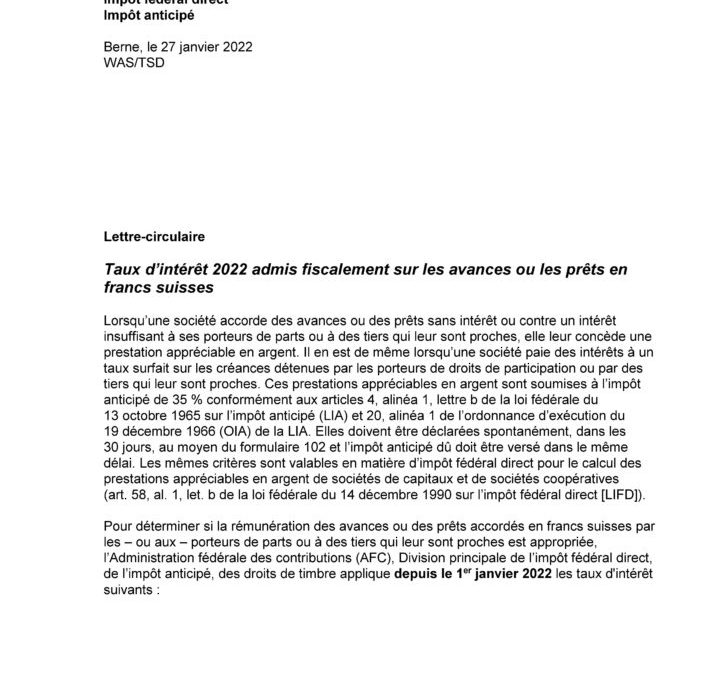
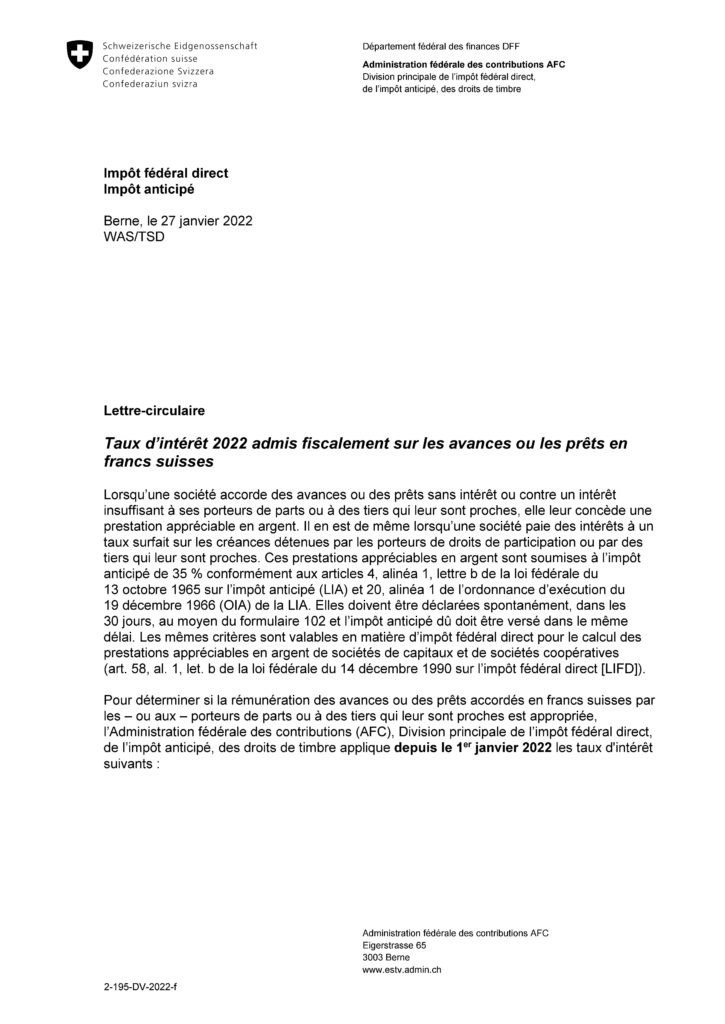
To determine whether the remuneration of advances or loans granted in Swiss francs is appropriate, the Federal Tax Administration applies the following interest rates annually:
Tax-allowed interest rate on advances or loans in Swiss francs
Tax-allowed interest rate on advances or loans in foreign currencies
AFC-CIRCULAR NO. 6
DIVIDEND - RULES
Dividend means the amount of profits that a public limited company pays to its shareholders.
The payment and the amount of a dividend are proposed by the management at the general meeting (or meeting of shareholders) and decided by the shareholders. There is no legal obligation to pay out all or only part of the profit.
The company can keep the profit to invest in a new machine or in a building, for example.
In Switzerland, the dividend is generally paid once a year.
Dividing the dividend by the share price gives its yield. It indicates the amount realized for each franc invested. The dividend yield combined with the rise in the share price gives the total return of the shares or investments.
In Switzerland, dividends are subject to income tax and withholding tax .
There are two types of dividends: dividends cash, which are paid in cash to the shareholder, and dividends in kind, which can be paid in the form of any assets of the corporation. It is common for companies to distribute shares of a subsidiary as dividends in kind and thus spin off from the subsidiary.
For limited liability companies (Sàrl), the term used is not dividend but profit distribution. The amount of dividends depends on the company's profit; generally, a portion of the profit is retained and allocated to reserves, for example, to finance investments. In some cases, a special dividend may also be paid independently of the annual surplus.
Ceiling amounts
In principle, the share of the salary and that of the dividend must be adapted. Benefit payments should be comparable with third parties and consistent with local and industry practices.
It should be noted on the one hand that an excessively high dividend payment, in the event of a manifestly disproportionate amount in relation to the salary, may be requalified by the compensation fund as a salary paid up to the usual remuneration in the sector. .
On the other hand, the tax authority may assume a hidden distribution of dividends in the event of the payment of excessive salaries to shareholders. This is always an overall consideration in a case-by-case review.
In federal taxation case law, the "Nidwaldian practice" has imposed itself to answer the question of a manifest disproportion between work and its remuneration, or between capital employed and dividends paid.
(ATF 134 V 297). According to this principle, declared AVS income and salary in accordance with industry practices are compared with dividend payments and share value to determine whether part of the distributed dividends should be considered as income determining contributions.
It is up to the compensation funds to independently assess whether an income component should be qualified as determining salary or capital income. However, the compensation funds must adhere to the point of view of federal tax law (Art. 23 RAVS).
A different view of tax authorities and social insurance institutions should be avoided if possible.
From a return on equity of more than 10%, the compensation funds assume that the dividend is excessive (ch. 2011.7 Guidelines on the determining salary in the AVS, AI and APG, status January 2016).
An exception to this principle is however possible, according to recent case law in the field of tax law, for example in the case of a substantive dividend (judgment of October 25, 2012; 9C_669/2011).
Substantive dividend
Dividends can be distributed not only on the net profit of the past financial year, but also on the substance (art. 675 al. 2 CO, open reserves). A distribution of dividends on a financial year with a loss is also possible insofar as the profit brought forward is higher than the loss.
According to federal tax law case law, an excessive dividend corresponding to a return on equity of more than 10% should not lead to reclassification as salary if it is a dividend taken from the substance and if a salary at least equivalent to the practices of thesector was paid during the period of hoarding of the company's profits (i.e. during the phase of building up the substance for subsequent dividend payments).
In other words, this means that a disproportionate dividend could not be requalified as a salary during the reserve constitution phase due to social insurance law if a salary in line with industry practice has been paid during these years. It does not matter if an appropriate salary was also paid in the year of payment of the substantial dividend.
At its meeting on May 19, 2021, the Federal Council decided that the revision of the law of succession would come into force on January 1, 2023.These new provisions will allow testators to freely dispose of a larger part of their assets.
The new inheritance law will be more flexible. Testators will be able to freely dispose of a larger portion of their assets.
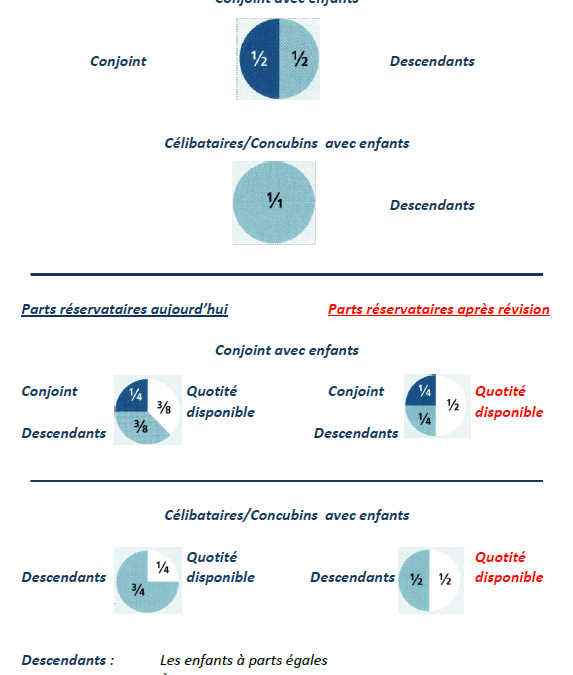
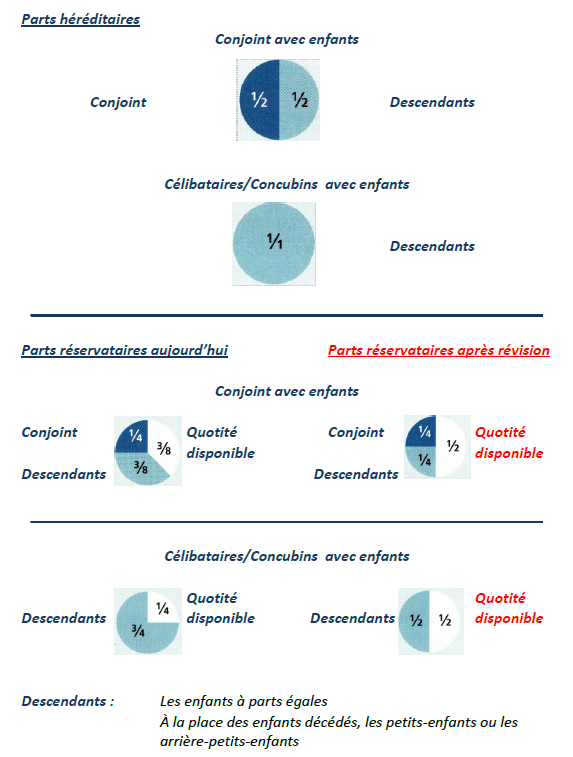
Currently, the children's reserved portion of the estate is equal to three-quarters of the legal share. In the future, it will be reduced to half. The parents' reserved portion, however, is being completely abolished.
The rights of the spouse or registered partner, however, remain unchanged. A person wishing to settle their estate by will will be less constrained by the forced heirship rules. They will be able to dispose of their assets more freely and, for example, favor their common-law partner more. The Federal Council has decided that the revised inheritance law will come into effect on January 1, 2023.
To better understand this case, here is some explanation of the legal terms used in inheritance law
Legal heirs
The legal heirs are those designated by law to inherit if the deceased did not express a last will and testament.
Inheritance rights vary according to the civil status of the deceased at the time of death and the degree of kinship of his survivors.
Legal heirs inherit according to a certain order of succession based on the degree of kinship or, more precisely, according to the order of kinship with respect to the deceased.
The closest relatives exclude those who are more distant. Therefore, the legal heirs are always those of the closest relatives.
The first group of relatives consists of the deceased's direct descendants, namely his children or their descendants. The children inherit in equal shares within each branch.
Adopted children or natural children inherit in the same way as legitimate children;
The second kin inherits when there are no descendants left. It includes the father and mother or, in the event of predecease, the brothers and sisters of the deceased or even their descendants if one of them has predeceased them;
The third group of relatives consists of the grandparents and their descendants. These include uncles and aunts, cousins, or their descendants.
The surviving spouse is outside the family circle since he/she is not related to it by blood.
Certain close relatives are legally entitled to a specific proportion of the inheritance. These forced heirs are:
The surviving spouse
The descendants
Inheritance share
The legal inheritance share is the portion of the inheritance to which a person is entitled by law, unless the testator has decided otherwise (e.g., with a will).
Reserved inheritance
The reserved portion is the minimum share of the inheritance, defined by law, to which a person is entitled; it is less than the statutory share. However, not all legal heirs are entitled to a reserved portion.
Only the spouse and children of the deceased are entitled to a mandatory share
If a will does not respect the reserved portion of the estate, it is not automatically void; it must first be contested by the legal heirs.
Available quota
The disposable portion is the share of the estate that remains after deduction of the reserved portions. The testator can bequeath this portion as they wish, to individuals or non-profit organizations, by means of a will or a succession agreement.
Swiss Will
The Swiss Civil Code provides for three forms of will: holographic, public, and oral. The holographic will is the simplest and most common form. It must be entirely handwritten, dated, and signed by the testator.
Swiss Inheritance Pact
A succession pact is a contract between two or more persons whose object is the succession of at least one of them.
Any person capable of discernment and aged 18 years or over may enter into a succession agreement.
With the agreement of the heirs, the testator can freely dispose of their estate without limit. For example, a forced heir can renounce all or part of their inheritance through this act.
The inheritance agreement may infringe upon the reserved portion of other heirs who are not participating in the contract.
In this case, the injured parties can assert their rights through an action against the other heirs (action for reduction).
The inheritance agreement is established in authentic form (before a notary).
Unlike a will, a succession agreement cannot be unilaterally modified. Any change must be made in the presence of a notary and with the participation of all parties
Changes for married couples
The inheritance rights of descendants will decrease.
Today, children are entitled to a reserved portion of 3/8 of their inheritance.
From now on this share will amount to 1/4. The disposable portion will increase from 3/8 to 1/2.
The testators will therefore be able to dispose of a larger share of the inheritance as they see fit
Married couples living in a blended family will be able, thanks to the increase in the disposable portion, to favour their own children, but also to take into account their stepchildren.
Spouses can better protect each other. This is especially important when the surviving spouse is dependent on income from the estate or must pay off the mortgage to keep their home.
Otherwise, he will at worst be forced to sell in order to reduce his fixed costs or to compensate the children.
A reduction in the reserved portion of an estate allows business leaders to more easily settle succession within their company.
Changes for unmarried partners
Inheritance law does not regulate cohabitation.
Without specific provisions, cohabiting partners and their children will therefore not be able to claim inheritance even after the revision of inheritance law.
Since these constellations can be very different, it is not the law but the testators who, even after the reform, will remain empowered to decide which people they wish to favor.
In the future, testators will have more leeway to do this, as the inheritance rights of descendants will decrease and those of parents will disappear entirely.
Cohabiting partners and blended families must also take steps to avoid an unfair situation when dividing an inheritance.
Anyone who has already settled their estate and drawn up, for example, a will should study with an independent specialist the points that need to be adapted due to the reform in order to avoid making mistakes.
Loss of the right to a reserved portion of the estate during divorce proceedings
Divorced spouses whose divorce decree is enforceable lose all rights to the other's estate; this also applies to registered partnerships.
The surviving spouse and registered partner currentlytheir right to the inheritance share and the reserved portion if the other spouse or partner dies during divorce proceedings.
Today, registered partners and married couples are equal before the law. With the revision, the spouse and the registered partner will lose their right to a reserved portion of the estate as soon as divorce proceedings are filed.
Until the divorce judgment is enforceable, the surviving spouse and registered partner will still be entitled to their legal inheritance share unless the testator has decided otherwise (e.g. through a will).
Passing the business on within the family is much more than just a legal challenge.
Simply favoring or disfavoring one family member over many others can harm family relations and generate multiple problems for the new owner.
Under the new inheritance law, the reserved portions constitute a smaller share, which facilitates transmission within the family.
Prospects for future review stages for family businesses
In a future stage of the revision of inheritance law, it is planned to facilitate the transfer of family businesses.
Family businesses are particularly threatened in the event of the owner's death if their estate is not settled.
Depending on the valuation of a company, its buyers must pay high compensation to their co-heirs who are protected by inheritance reserves.
This can put a company in difficulty or even lead to its fragmentation if a large part of the assets are tied up in the company.
The revision aims, among other things, to allow the deferral of payment of compensation if the company has insufficient liquidity for an immediate payment.
Legal inheritance shares, reserved portions and disposable portion
SWISS CIVIL CODE – INHERITANCE LAW
RO 2021 312 OF 18 December 2020 – ENTERING INTO FORCE ON 1 JANUARY 2023
2 Divorced spouses cease to be each other's legal heirs.
3. Unless otherwise stipulated, the spouses lose all benefits resulting from testamentary dispositions:
1. at the time of the divorce;
2. at the time of death if divorce proceedings resulting in the loss of the surviving spouse's reserved portion are pending.
Article 216, paragraphs 2 and 3
2 The participation in the profit allocated in excess of half is not taken into account for the calculation of the inheritance reserves of the surviving spouse or registered partner as well as of the common children and their descendants.
3 Such an agreement cannot infringe upon the reserved portion of children from a previous relationship and their descendants.
2 The same applies in the event of dissolution of the regime due to death, when divorce proceedings resulting in the loss of the surviving spouse's reserve are pending.
Art. 241, para. 4
4 Unless otherwise stipulated in the marriage contract, the modification of the legal division does not apply in the event of death when divorce proceedings resulting in the loss of the surviving spouse's reserved portion are pending.
Art. 470, para. 1
1. Anyone who leaves descendants, their spouse or registered partner has the right to dispose of what exceeds the amount of their reserved portion upon their death.
Art. 471
II. Reserve
The reserved portion is half of the inheritance tax.
Art. 472
III. Loss of the reserved portion in the event of divorce proceedings
1. The surviving spouse loses their reserved portion if, at the time of death, divorce proceedings are pending and:
1. The proceedings were initiated by joint application or continued in accordance with the provisions relating to divorce by joint application, or
2. The spouses have lived separately for at least two years.
2 In such a case, the reserves are calculated as if the deceased had not been married.
3 Paragraphs 1 and 2 apply by analogy to the procedure for dissolving a registered partnership.
Art. 473
IV. Usufruct
1 Regardless of how the disposable portion is used, the spouse or registered partner may, by disposition in cause of death, leave the survivor the usufruct of all the share devolving to their common descendants.
2. This usufruct serves as the inheritance right granted by law to the surviving spouse or registered partner in conjunction with their descendants. In addition to this usufruct, the disposable portion is half of the estate.
3. If the surviving spouse remarries or enters into a registered partnership, their usufruct ceases to encumber, for the future, the portion of the estate that, at the testator's death, could not have been the subject of the bequest of usufruct according to the ordinary rules on the reserved portion for descendants. This provision applies by analogy when the surviving registered partner enters into a new registered partnership or marries.
Art. 476
3. Life insurance and related individual pension plans
1 Death insurance policies taken out on the life of the deceased, including within the framework of linked individual insurance, which he contracted or disposed of in favour of a third party by inter vivos act or on account of death, or which he transferred free of charge to a third person during his lifetime, are added to the estate only for the surrender value calculated at the time of death.
2. The claims of the beneficiaries resulting from the individual pension plan of the deceased with a banking foundation are also added to the estate.
Art. 494, para. 3
3. However, testamentary dispositions and inter vivos gifts that exceed customary gifts may be challenged to the extent that:
1. where they are incompatible with the commitments arising from the inheritance agreement, particularly when they reduce the benefits resulting from the latter, and
2. where they were not reserved in this pact.
Art. 522
B. On the action for reduction I. Conditions 1. In general
1. Heirs who receive an amount less than their reserved portion have the right to bring an action for reduction, until the reserved portion is restored, against:
1. Acquisitions by reason of death resulting from the law;
2. Gifts made in contemplation of death, and
3. Gifts between living persons.
2. Provisions made in contemplation of death relating to the shares of legal heirs are considered to be simple rules of partition if they do not reveal a contrary intention on the part of their author.
Art. 523
2. Reservation holders
Acquisitions upon death resulting from the law and gifts upon death benefiting the forced heirs are reducible proportionally to the amount that exceeds their reserved portion.
Art. 529
4. Life insurance and related individual pension plans
1 Death insurance policies taken out on the life of the deceased, including within the framework of linked individual insurance, which he contracted or disposed of in favour of a third party by inter vivos act or on account of death, or which he transferred free of charge to a third person during his lifetime, are subject to reduction for their surrender value.
2. Claims of beneficiaries resulting from the deceased's individual linked pension plan with a banking foundation are also subject to reduction.
Art. 532
III. On the order of reductions
1. The reduction is applied in the following order until the reserve is reconstituted:
1. on acquisitions due to death resulting from the law;
2. on gifts made in contemplation of death;
3. on gifts inter vivos.
2. Gifts inter vivos are reduced in the following order:
1. Gifts made by marriage contract or by agreement on property which are taken into account for the calculation of reserves;
2. freely revocable gifts and benefits from tied individual pension plans, in the same proportion;
3. the other gifts, going back from the most recent to the oldest.
II
The modification of other acts is addressed in the appendix.
III
1 This law is subject to referendum.
2 The Federal Council sets the date of entry into force.
Council of States, 18 December 2020 The President: Alex Kuprecht The Secretary: Martina Buol
National Council, December 18, 2020 President: Andreas Aebi Secretary: Pierre-Hervé Freléchoz
Expiration of the referendum deadline and entry into force
1 The referendum period applicable to this law expired on April 10, 2021 without having been used.[3]
2 This law enters into force on January 1, 2023.[4]
May 19, 2021
On behalf of the Swiss Federal Council: The President of the Confederation, Guy Parmelin; The Chancellor of the Confederation, Walter Thurnherr
2. Unless otherwise stipulated, the partners lose all benefits resulting from provisions in respect of death:
1. at the time of the dissolution of the partnership;
2. at the time of death if a dissolution procedure resulting in the loss of the surviving partner's reserve is pending.
2. Law of 25 June 1982 on occupational old-age, survivors and disability insurance[6]
Article 82 Equivalent treatment of other forms of social protection
1. Employees and the self-employed can also deduct contributions allocated exclusively and irrevocably to recognized forms of social protection considered equivalent to occupational pension plans. The following are considered as such:
a. Individual linked pension plan with an insurance institution;
b. Individual pension plan linked to a banking foundation.
2 The Federal Council determines, with the collaboration of the cantons, to what extent the deductions referred to in paragraph 1 are permitted.
3. It establishes the terms and conditions of recognized forms of pension provision, in particular the circle and order of beneficiaries. It determines the extent to which the policyholder may modify the order of beneficiaries and specify their rights; the provisions made by the policyholder must be in writing.
4. Beneficiaries of a recognized form of social protection have a specific right to the benefit that this form of social protection entitles them to. The insurance company or banking foundation pays the benefit to the beneficiaries.
Upon reaching retirement, some "good customers" are surprised to suddenly find themselves considered bad debtors by their bank.
Depending on their financial situation and the degree of amortization of their mortgage, retired clients are advised to sell their house or apartment.
Depreciation required
If, as a general rule, a mortgage loan is granted for residential real estate up to 75-80% of the value of the property for working clients under 55 years of age.
This percentage will drop drastically to around 50% / 60% at the time of retirement!
The general rule applied for the charge/interest ratio is that the cost of the mortgage calculated on the basis of an average rate of 6.5% should not exceed one third of the income.
It is easy to understand from the above that a large proportion of seniors are likely to find themselves in very unpleasant situations in the near future, this phenomenon being further accentuated by a decrease in LPP pensions and an additional decrease for those who have used part of their LPP capital for access to property.
According to the analyses, only 40% of property owners will be able to meet the banks' financing criteria when they no longer have a gainful activity, 40% will have to take austerity measures and 20% will find themselves in a difficult situation to bear.
Real estate strategy for retirement
1 – Investing in mortgages, amortizing?
A mortgage isn't necessarily a burden. A mortgage loan can be an investment alternative that offers reassurance in this period of negative interest rates.
This opportunity is possible, but it comes at a tax cost, especially since our tax system for private rental values does not help matters and it is felt more or less heavily depending on the Canton.
2 – Saving in the third pillar and/or possible redemption in LPP?
In this way you save on taxes and will have more money available in retirement to adapt your home or reduce your mortgage.
Saving for retirement is no longer possible; what measures can be considered?
Passing on one's house to children while retaining a right of habitation or usufruct.
That the children (if their income is sufficient) become joint and several debtors for the mortgage loan.
And if the loan-to-value ratio allows, you can create a "bank annuity ." The mortgage is increased, and part of this credit can be used to immediately cover the interest payments for the next 10 to 15 years at a fixed rate, with the remainder used to supplement your income. Banks are rather hesitant about this.
As a long-term solution, and if the loan-to-value ratio allows, a life annuity can be established—a "life annuity, with or without repayment ." The mortgage is increased, and the loan is used to finance an immediate life annuity, thus balancing the loan-to-interest ratio and improving income. The annuity is pledged to the lender. Clearly, this solution will reduce the capital to be passed on to heirs.
Sale with life annuity
The principle is simple: people of a certain age or retired sell their house at a price below market value.
In exchange, he lives there until their death without paying rent and, sometimes, even receiving a supplementary annuity.
He also receives a lump sum upon conclusion (the initial payment) allowing for immediate liquidity.
The potential buyer will therefore consider the possible profit, which is the market value of the property minus the initial deposit (the down payment). But also, and this is the most delicate aspect, the amount of any potential annuity, multiplied by the number of months until the seller's potential death.
In summary:
For future seniors (of which we are all a part) who are already homeowners, it is necessary to anticipate, analyze and implement exit strategies as soon as possible.
It is clear that the third and fourth age are not really suited to direct real estate investments and that for this category of investors it is better to turn to indirect real estate investment which exists in different forms.
I remain at your disposal to discuss this further.
The global tax landscape is changing with repercussions for Switzerland and the companies based there.
According to the roadmap established by the OECD and the G20 countries, the first elements of a minimum tax should come into force on January 1, 2023.The Federal Council has therefore decided to implement the minimum tax through a constitutional amendment and to ensure, by means of a transitional ordinance, that the minimum tax can be introduced on January 1, 2024. Voters will be called upon to decide on this matter on June 23, 2023.From a tax perspective, Switzerland remains an attractive place for both businesses and individuals, but with the introduction of a global minimum tax on large corporations in mind, some cantons must prepare to tax them more heavily. In light of the reforms envisioned by the OECD and the G20 countries, which plan tointroduce a minimum corporate profit tax rate of 15%, the differences between cantons with low corporate tax rates, such as Zug (11.85%), and Bern (21.04%), which levies high taxes, are expected to diminish. However, the OECD's proposed minimum 15% tax rate will only apply to companies with annual revenues exceeding €750 million.In French-speaking Switzerland, the cantons of Vaud and Geneva have set their corporate profit tax rates at 14%, Neuchâtel at 13.57%, Fribourg at 13.87%, Valais at 17.12%, and Jura at 16%. Compared to the OECD's minimum rate of 15%, the difference is not very large, and these cantons will only need to make minor adjustments to comply with OECD rates. In German-speaking Switzerland, the canton of Zug leads the ranking with a rate of 11.9%, followed by Nidwalden (12.0%) and Lucerne (12.2%). With a rate of 21.0%, the canton of Bern is at the bottom.
2022 Corporate Tax Rates in Switzerland: In international comparison, companies are taxed lightly in Switzerland. Rates lower than those in low-tax cantons are only found in traditional offshore jurisdictions, Guernsey, Qatar, and a few Eastern (Southeast) European countries. Ireland remains Switzerland's main competitor in Europe. Internationally, large Swiss companies will also be subject to the same rules as those located in cities like Singapore, Hong Kong, or Dubai, which will also have to raise their tax rate to 15%. There will therefore be fewer incentives encouraging companies to relocate to such locations solely for tax reasons. For very large corporations, tax competition between cantons will play a less significant role as a factor in future location decisions. Whether these corporate tax developments will have consequences for personal income tax remains to be seen.
To provide the best experiences, we use technologies such as cookies to store and/or access device information. Consenting to these technologies will allow us to process data such as browsing behavior or unique IDs on this site. Failure to consent or withdrawing consent may negatively impact certain features and functions.
Functional
Always On
The storage or technical access is strictly necessary for the purpose of legitimate interest to allow the use of a specific service explicitly requested by the subscriber or user, or for the sole purpose of carrying out the transmission of communication over an electronic communications network.
Preferences
The storage or technical access is necessary for the legitimate interest purpose of storing preferences that are not requested by the subscriber or user.
Statistics
Storage or technical access used exclusively for statistical purposes.Storage or technical access used exclusively for anonymous statistical purposes. In the absence of a subpoena, voluntary compliance from your internet service provider, or additional records from a third party, information stored or retrieved for this sole purpose generally cannot be used to identify you.
Marketing
Storage or technical access is necessary to create user profiles in order to send advertisements, or to track the user across a website or across multiple websites with similar marketing purposes.